Field notes from user research on Partnership Design

Over the course of developing the partnership canvas, I’ve talked to partnership professionals to hear from them about how they work, and what their experience is in forging business collaborations.

In this post, I would like to share some of the insights from my research, and show how they have lead me to develop the key features for the Partnership Canvas, and the partnership design process. I’ll use the Value Proposition Canvas to visually depict how the Partnership Canvas as a product provides value to people working in the profession.

At the end of the post, I will share a special offer with you to learn more about Partnership Design, and using the Partnership Canvas tool.

The partnerships professional
Partnership managers are a unique species of people. They’re involved in company strategy, as well as in operations of the divisions. Partnership professionals help sales, marketing, product development teams to achieve their goals for growth through collaborations, rather than creating it themselves entirely. They are not formally part of any of these teams/divisions, but they do work closely with them. The partnership professional is thus a business all-rounder.

To find out what some of the key aspects of the profession are, I’ve interviewed a couple of dozen partnership professionals, who I’ve gotten to learn through this blog, and partnership workshops.

Below you will find a summary of my key findings thus far. I’ve focused the presentation of my results on describing the key outcomes partnership professionals are looking to achieve in their work (the Jobs), and their most significant experiences in the process of achieving them (Pains, and Gains). Secondly, I look at the Partnership Canvas as a solution that partnership professionals can utilize, and how it addresses their most important jobs, pains, and gains.

The partnership professional’s profile

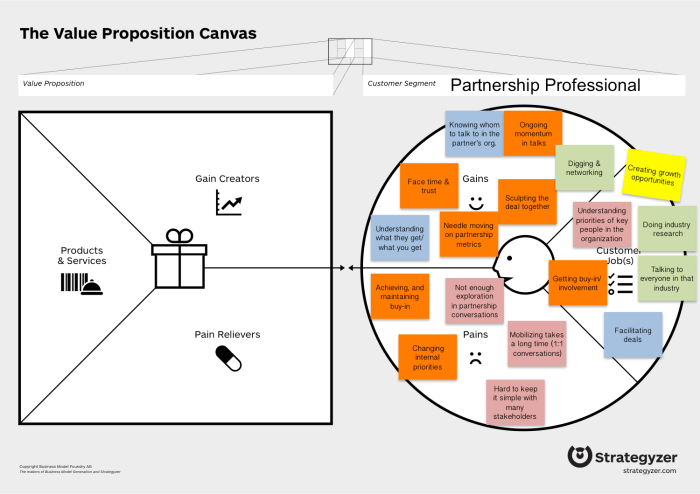
Jobs
The higher-level goal of partnership professionals is to create new growth opportunities for their organization, through cooperating with other companies. They are looking to achieve the following outcomes to accomplish this growth goal:

  • Understanding the priorities of all the key people in the organization.
  • Getting involvement from key people in the organization, and maintaining their involvement.
  • Doing research on industries, and specific companies to partner with
  • Talking to everyone in those industries.
  • Creating collaboration opportunities, and facilitating deals.

Gains
The following gains, are the positive experiences that come from working to the desired outcomes:

  • Knowing whom to talk to within the partner’s organization
  • On-going momentum in partnership conversations
  • Face time and trust in negotiations; keeping out legal until there is a clear narrative for the partnership
  • Getting into a flow of sculpting the deal together
  • Understanding what they get, and what you get.
  • Seeing the needle move on key metrics for the partnership
  • The satisfaction that comes from building out networks, and finding out intricate industry insights.

Pains
Lastly, partnership professionals experience the following pains in their jobs:

  • Convincing needed to get buy-in on the vision for the partnership, both externally, and internally
  • Not having enough space to explore a potential collaboration with partners.
  • Mobilizing people internally takes a long time. Lots of long talks, iterating along the ranks.
  • Changing internal priorities and people changing positions.
  • Hard to keep it simple: Every stakeholder adds on a layer of complexity for executing on the partnership

The figure below, visualizes these jobs, pains, and gains, and shows how they connect through color-coding.
The Partnership Professional

The solution
Lets now look at the Partnership Canvas as a product, and some of pain relievers, and gain creators that it and the Partnership Design process provides to help partnership professionals succeed at their game.

Product
The Partnership Canvas is a visual business tool that captures the essential design elements of a partnership deal. Together with the Partnership Design process, it creates a method for understanding, designing, and testing business model partnerships.

Gain creators
The Partnership Canvas is an add-on to the Business Model Canvas. This enables it to tap into the power of the Business Model Canvas to understand, and design businesses. As such the tool  can be used for research on other business models, and partnership in an industry.  The connection with the Business Model Canvas also creates linkages with Lean Startup methodology, turning partnerships into testable business model experiments.

The partnership tool is also a simple, easy to understand visual tool. It asks for all the relevant insights, which are needed to create a complete understanding of a partnership.

Pain relievers

  • The Partnership Canvas is an agile tool, which facilitates quick communication, and decision making around business options.
  • The Partnership Design steps start with exploration of partnering options, before moving into experimentation and implementation.
  • The tool brings focus to partnership discussions. This also helps people with different (non-business) backgrounds, and disciplines to quickly understand and decide what is needed to build a productive partnership.
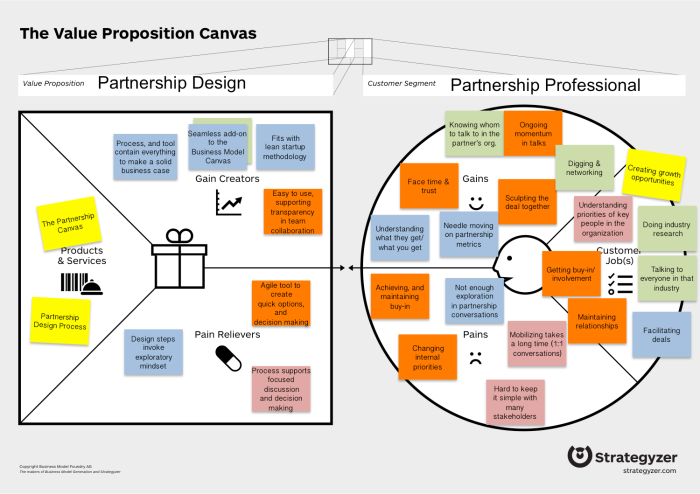
Partnership Design as a solution for the partnership professional

This is still an ongoing research project, and I haven’t covered the full depth of partnership professionals’ field of work yet. I keep learning from every new conversation I enter. I’d love to hear your thoughts on the profile I’ve compiled so far, and also about other tools, and methods that you use yourself to design partnerships. Do comment, or send me an email to info@partnersipcanvas.com if you’d like to talk further!


Interested to learn more about Partnership Design?

Check out Training opportunities!

or

You can join the Partnership Design Linkedin group!

Further inquiries? Send an email to: info@partnershipcanvas.com

Transfer activity in partnerships: providing mutual access to each others business models

One of the most frequently recurring questions I get during partnership design workshops is about the transfer activity: “What is it? Can you give me an example?”

In this blog post I will therefore dive a bit deeper into this building block. Firstly, I will describe a bit about the building block’s background. Then I’ll describe what the crucial role is of the transfer activity in distributing value between partners.

Background on transfer activity.
Partnerships enable the access, and flow of resources between partners (Mowery et al. 1996). Part of creating this flow is based on synergy between the resources that partners bring in: what’s their polar attraction, and how strong is it? The other part comes from building the conduits through which partners can connect these resources. How will they provide each partner with access to the resources, and enable them to create value with the partnership. This is where the notion of transfer activity comes in.

Transfer activity describes how exchange of knowledge, technology, and other value elements between partners takes place. Transfer could occur in the form of in-person collaboration between people from both sides of the partnership. It could also be in the form of a more structural (technology) platform where partners can access resources independently, based on prior agreement in their partnership designs.

An appropriate metaphor would be to use a certain stage in a relationship between people. Say you’re taking your relationship to the next level, beyond just dating, and you’ll be inviting each other over to your houses frequently. Now the questions is how will you let each other in? Will you exchange copies of the key, or will it be a string through the door at agreed times? Both provide access, but the nature of the transfer is very different, and important to understand, and agree upon upfront.

Distributing value in a partnership through the transfer activity
The transfer activity has a key role in the partnership. There’s a reason it’s positioned in the middle of the Partnership Canvas (see diagram below). Essentially it has two functions. Firstly, transfer activity connects the value elements that partners put into the partnership. Secondly, it enables the creation of the new form of value that each partner takes back to his or her own business model. Lets look at both of these roles a bit closer.

Screen Shot 2016-05-24 at 09.58.53
A full overview of a partnership with the Business Models of both partners (rectangles), and the Partnership Model (triangles) with the Transfer Activity (highlighted)

The first role of the transfer activity is to connect the desired assets with the value offer. There are two general approaches to set up this mode of transfer:

  1. Interpersonal collaboration.
    In this case your partnership depends on joint coordination and decision making a lot. An example of such a partnership is Nespresso and its machine manufacturers, like Krups and DeLonghi. Their collaboration depends on joint design of (new) machines, and setting up the appropriate marketing that fits both of their channels.
  2. Access via specifically structured technology
    Many information technology partnerships use rule-based transfer activities. Partners define the access that each can have to data, and other forms of IP through agreements on access permissions, and use. In a collaboration like Lyft and Didi in China you’ll see such a transfer activity. Lyft users can hail Didi taxis in China through use of the Lyft app. The transfer activity is an automatic transfer of the order from one system to the other.

When designing options for this transfer, it is important to also take a temporal consideration on the exchange of value. Will the transfer be a frequent, and recurring activity? Or is it more likely going to be a limited and short-term action?

These questions help point to a critical aspect of duration for the partnership. In the case of frequent, and recurring interaction, partners remain dependent on each other for value creation, like in the examples of Nespresso and Lyft above.

In the latter case of limited, or short-term collaboration, dependency expires due to gradual learning and other forms of value appropriation that takes place on both sides of the table. The Tesla-Toyota partnership is a good example here. This partnership expired when Tesla internalized the process of mass manufacturing for their Model S, which Toyota engineers helped them get started with, and Toyota engineers learned about Tesla’s battery technology.

The second role of the transfer activity is to create a new form of value, which can be inserted and activated in each partner’s business model. Taking the examples above again, the Nespresso transfer activity would create the offering of the Nespresso machine as part of the value proposition. Also, it helps create the content that will stream through the partners’ market channels. In the case of Lyft and Didi, the partnership gives Lyft an extension of their active geography to their existing users. For Didi it means a new channel, tapping into a new customer base of travelers coming from the US to China.

Conclusion
What I see happen a lot is that partners define synergy, and then tend leave their partnership designs at that, assuming everything else will fall into place after. They neglect to define how they will actually grant each other access to each others resources, and how they will create the actual value that is needed to run their business models better. They’ll likely be confronted with the problem of deciding how to exchange value and differences in perspectives on that, very late, if not too late, in the game.

So, setting up a solid mode for transfer activity, and addressing this discussion early on in the design process is crucial. Take time in the dialogue with your partner to figure out the transfer activity, and make sure that you understand from each other how you will collaborate in your exchange of value.

Literature reference:
Mowery, D., Oxley, J., and Silverman, B. (1996) “Strategic Alliances and Interfirm Knowledge Transfer”, Strategic Management Journal, Vol. 17 (Winter Special Issue), p. 77-91


Interested to learn more about Partnership Design?

Check out Training opportunities!

or

You can join the Partnership Design Linkedin group!

Further inquiries? Send an email to: info@partnershipcanvas.com