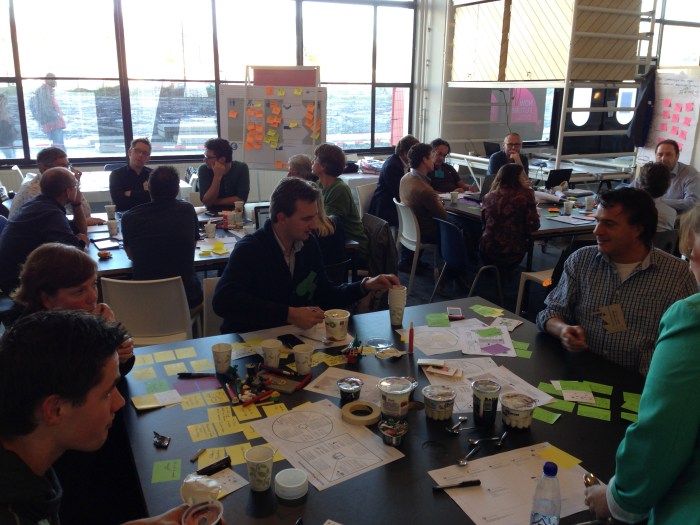
I would like to share an observation I’ve made on the first Agri meets Design event, which took place during this year’s Dutch Design Week. Overall, the event has achieved a fresh, tangible perspective for the encounter of agriculture and design, which looks very promising. Yet despite this promise, I also have a concern with regards to inherent tendencies in both agriculture and design, which need to be addressed before the connection can really be made to flow.
Agriculture is an engineering-dominated arena, where existing decision making settings, and existing technology all too easily guide solution development. The new perspective brought by design has opened up for a more exploratory mindset: a big achievement! Most notable example of this from the event is the case of the Polderhack, where open data on food and agriculture was mashed into prototypes for applications addressing interesting use cases.
Despite this achievement in opening up a closed conversation, design is not without its own defaults. Through listening to various people during the Agri meets Design event, and in attendance of a few other side events, I see that design tends to limit itself to the space of opportunity/problem definition: the space of art and invention (projects like the Solar Sinter). Yet, real impact lies in completing the chain of development to defining solutions for implementation and adoption, ie. innovation.
I see this as an unaddressed part of the “meet”. If it isn’t addressed then I suspect an emerging law of social physics will tend to kick in in this space: Polarization caused by engineers staying on one side of the equation, whilst designers stay on the other. (this problem was aptly brought into real world terms by this goat farmer (in Dutch @1m:16)
In order to materialize the gains from the crossover between agriculture and design, I thus think there is a requirement for a new chain of collaboration between agricultural engineers and designers, so that thoughts from the space exploration can be transferred to results in the space of execution. Perhaps a design challenge for next year. I’d be happy to participate!
In my previous post I’ve written about the limitations we encountered in applying the value chain approach when my team I wanted to understand how information and knowledge adoption and exchange works with farmers within their agricultural market system. What we were in effect mapping out appeared not to be a chain, but rather a network, or a web, for sharing information and knowledge. I’ve received some interesting responses on this post in the “Value Chain Thinking” group on Linkedin (requires administrator permission to join), as well as offline. The prevailing question posed to me was: “what have you observed that might work as an alternative for value chain mapping then?”
I don’t have this alternative ready. But, I won’t leave it at that. In this post I would like to share some observations on the patterns on information exchange my team and I saw in this web, and on its “components”. This in attempt to help improve the process of realizing understanding when conducting market system mapping exercises.
Patterns in the web We started off with an attempt to map out the value chain, both in the context of Maharashtra in India, and in several areas of rural Kenya. The webs that resulted were too complex to enlighten us in our research. In search for an alternative approach to better illuminate how the system works, we took things back to the basics. We went through the conversations we had with several of the actors within the value chains in each of the countries (particular those conversations where we interacted with farmers). We then compiled profiles of these people to help in seeking patterns on information exchange within the complex maps we sketched out earlier.
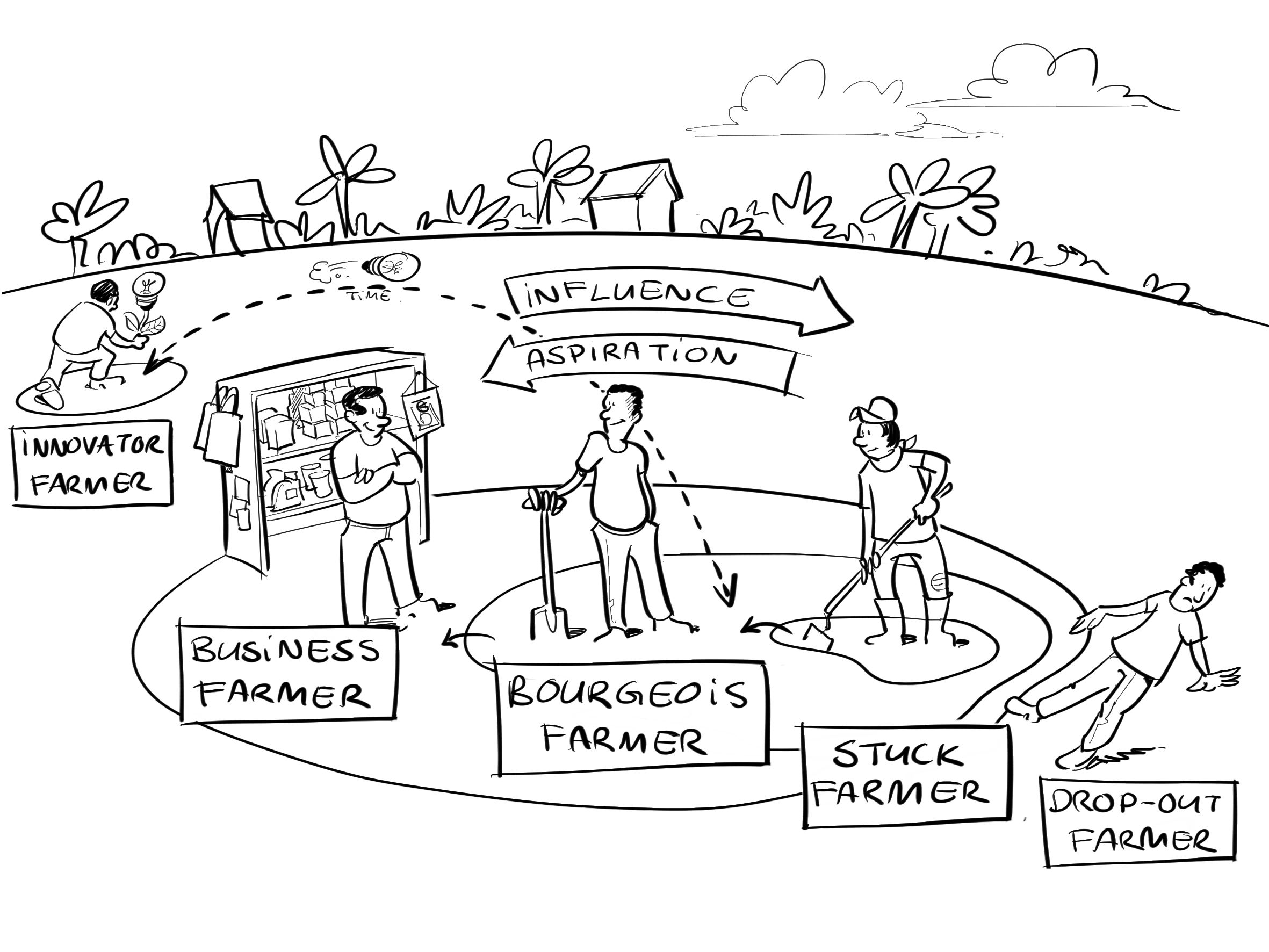
The following farmer-types emerged from the data we were working with:
innovator farmers: people with a very broad worldview, looking outside their local context for interesting things to try. They are usually not (active) members of their immediate community
business oriented farmers: a farmer who is on top of the farming community, using it to pool supply for the market, someone who acts as a node in information gathering and exchange, and also can be selling inputs to the community.
bourgeois farmers (the large majority of the farming community); people who have been able to make a step forward, usually due to improvement in infrastructure, sometimes even moving there from the “stuck” situation. Despite their relative advancement they are still conservative in their aspirations.
Stuck farmers: farmers that are subject to slow decay of their land holding. They just about make ends meet enough to sustain their livelihoods. They’re main goal is to allow their children to advance, not so much focusing on opportunity for themselves
Drop-out farmers: farmers who have no chance of sustaining their livelihoods and are likely to abandon their holding in the short to medium term
Consequent to this profiling, we looked at the interaction between these farmer types, to understand how the web of knowledge exchange and adoption between them would work. We observed that interactions between these farmer types could be differentiated and layered according to who the influencer is amongst them, who is being influenced, and what peoples’ aspirations are to achieve within the system.
In other words by taking a simplification of peoples’ conceptual worldviews of influence and aspiration, a mapping emerged of an information and communication exchange ecosystem amongst farmers. We have tried to capture our perspective on this ecosystem and its different layers in the sketch below.
An information exchange ecosystem (visual by Jeroen Meijer of JAM Visual thinking)
Looking at the sketch in more detail it generally indicates that exchange doesn’t flow fully and freely within the ecosystem. There are people that subscribe to a certain part of the ecosystem, and information flows more easily and directly between them. This due to connecting worldviews that people in these groups have. There are also people who aren’t part of this section of the system (like the innovator), and information flows differently. Here, unconnecting worldviews are cause for a barrier to exchange.
People in the web As a second step to understanding exchange, we attempted to identify key determinants that could show how farmers operate in their part of the ecosystem, what sources they would use for information, and what they could consequently do with that information and how they would apply it. The sketch below shows our thinking on these determinants.
A farmer persona template in relation to information exchange
A farmer in each part of the ecosystem could be characterized according to 2 dimensions:
a static dimension of information on her holding, categorized according to timing of cash flow (and the uncertainty thereof) generated from various crops, animals, and alternative non-farming sources of income.
a dynamic dimension consisting of the farmer’s dreams, and aspirations on the one hand, and networks that the farmer belongs to on the other.
In this model changes in aspirations and networks, influence decisions made in planning out farming cash flows, and thus how the land is to be tilled and what investments will be made. By influencing aspirations and information that trickles through the network, this model would predict changes in management of the farm holding.
A different perspective Taken together, what we have created is a conceptual model for understanding information adoption and exchange in the rural context of India and Kenya. By no means is this a complete method, nor the information validated as fully representative. More research is needed (*cough*). But by separating the communities of information exchange in an ecosystem, and by looking at the different members within these communities we have broken down a theory that could inform how information:
enters an ecosystem and is collected
is aggregated
interaction and dissemination takes place.
In other words we have compiled a theory of what an existing ecosystem of information and knowledge exchange looks like, and linked it to a behavioral model of how people work with, and respond to that system. Perhaps such a composition could be used as a premise for further research that will inform the design of appropriate ecosystem “grapevine pipelines”, which can provide contextually relevant and timely information to a targeted group of farmers who voice the need for it. After all, progress by technology comes from emulating the structures of human interaction that already exist. Our work continues…
PS. I came across a super informative video through Ken Banks’ twitter handle @kiwanja. It’s made by Dr. Clint Rogers, collating a couple of invaluable lessons on failure in ICT4D projects. Some points mentioned above resonate with the points delivered in the video. Do have a look at it, highly recommended!
——————
This is the seventh piece in a continuing series of posts (starting here) on what the role of human-centered design could be in development work. I’m working on this together with Niti Bhan, who will also be posting her observations at her Perspective blog. Posts are categorized as VCD


 Partnership Design