In one way or another, we’re all linked to agriculture. Food availability is the basis for building any civilization. But what we’re also hearing is the challenges that agriculture has to meet. The world population is expanding and soon we’ll have to sustain 9 billion people. There is pressure on critical natural resources, like water, soil, fuel. And this is all happening amidst unprecedented change in the global political and economic landscape.
The good news is that this challenge to agriculture is widely recognized. Issues on agriculture are climbing up the agenda’s in an increasing number of fora. The bad news is though that agriculture is stuck. And by stuck I mean that key players in the field are not reaching the level of dialogue that is needed to meet the challenge at hand. It’s industrial agriculture vs organic agriculture, pro-GMO vs non-GMO, omnivores vs vegans., agronomy vs farmers’ intuition, etc vs etc.
With this form of conversation, solutions remain isolated as foreign languages and don’t connect. They’re caught inside the buildings where agriculture is professed, while the facts and answers to our problems are outside, where farming is practiced. Such a conversation landscape overemphasizes differences between tribes, aggravating opposing views, rather than enabling recognition and utilization of mutual strengths and gains from trade. Only conservative, incremental tweaking can come from this, while what the world acutely needs is a fundamental rework of how we produce and distribute food.
What can we do about it? Despite the negative effects of polarities in the system, you can also look at it in another way. Wouldn’t it be great if we can use this diverse body of experience and knowledge available and leverage complementarities, rather than allowing the usual patterns of interaction to emphasize disconnect? Wouldn’t that enable a broad sensemaking inquiry into the problems at hand in our agricultural system, rather than remaining at refinement exercises within our own disciplines? Wouldn’t vested views on problems then turn into challenging assumptions that are to be examined and tested?
We need to create an enabling space where these new conversations can be started, conversations with ideas that will fire innovation; discipline to discipline, people to people. Ideas that progress from such conversations will likely create new paths of solution development, lowering barriers to adoption of new, game changing ideas by nature of having traversed that path. This is, I think, what we can expect when we build a space where agriculture meets design.
——————————-
Me and my colleagues will be active on the Agri Meets Design platform at the Dutch Design Week in October in Eindhoven, working with farmers and multidisciplinary design teams on experience and business model design. There will be many more equally excellent or even better events given by the partners who made Agri Meets Design possible! I hope to also see you there! Ping me on twitter if you’re interested to connect!
In my previous post I’ve written about the limitations we encountered in applying the value chain approach when my team I wanted to understand how information and knowledge adoption and exchange works with farmers within their agricultural market system. What we were in effect mapping out appeared not to be a chain, but rather a network, or a web, for sharing information and knowledge. I’ve received some interesting responses on this post in the “Value Chain Thinking” group on Linkedin (requires administrator permission to join), as well as offline. The prevailing question posed to me was: “what have you observed that might work as an alternative for value chain mapping then?”
I don’t have this alternative ready. But, I won’t leave it at that. In this post I would like to share some observations on the patterns on information exchange my team and I saw in this web, and on its “components”. This in attempt to help improve the process of realizing understanding when conducting market system mapping exercises.
Patterns in the web We started off with an attempt to map out the value chain, both in the context of Maharashtra in India, and in several areas of rural Kenya. The webs that resulted were too complex to enlighten us in our research. In search for an alternative approach to better illuminate how the system works, we took things back to the basics. We went through the conversations we had with several of the actors within the value chains in each of the countries (particular those conversations where we interacted with farmers). We then compiled profiles of these people to help in seeking patterns on information exchange within the complex maps we sketched out earlier.
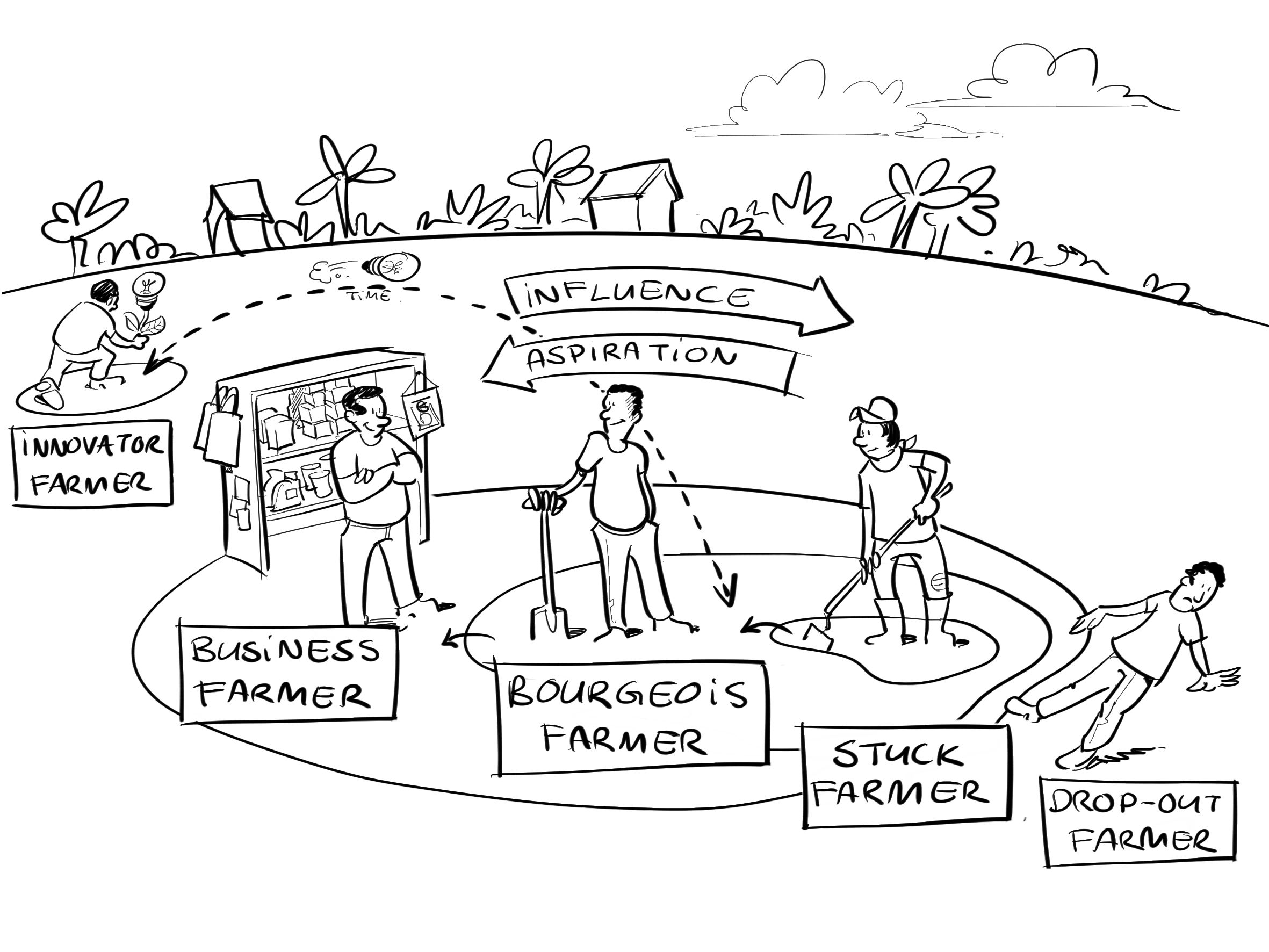
The following farmer-types emerged from the data we were working with:
innovator farmers: people with a very broad worldview, looking outside their local context for interesting things to try. They are usually not (active) members of their immediate community
business oriented farmers: a farmer who is on top of the farming community, using it to pool supply for the market, someone who acts as a node in information gathering and exchange, and also can be selling inputs to the community.
bourgeois farmers (the large majority of the farming community); people who have been able to make a step forward, usually due to improvement in infrastructure, sometimes even moving there from the “stuck” situation. Despite their relative advancement they are still conservative in their aspirations.
Stuck farmers: farmers that are subject to slow decay of their land holding. They just about make ends meet enough to sustain their livelihoods. They’re main goal is to allow their children to advance, not so much focusing on opportunity for themselves
Drop-out farmers: farmers who have no chance of sustaining their livelihoods and are likely to abandon their holding in the short to medium term
Consequent to this profiling, we looked at the interaction between these farmer types, to understand how the web of knowledge exchange and adoption between them would work. We observed that interactions between these farmer types could be differentiated and layered according to who the influencer is amongst them, who is being influenced, and what peoples’ aspirations are to achieve within the system.
In other words by taking a simplification of peoples’ conceptual worldviews of influence and aspiration, a mapping emerged of an information and communication exchange ecosystem amongst farmers. We have tried to capture our perspective on this ecosystem and its different layers in the sketch below.
An information exchange ecosystem (visual by Jeroen Meijer of JAM Visual thinking)
Looking at the sketch in more detail it generally indicates that exchange doesn’t flow fully and freely within the ecosystem. There are people that subscribe to a certain part of the ecosystem, and information flows more easily and directly between them. This due to connecting worldviews that people in these groups have. There are also people who aren’t part of this section of the system (like the innovator), and information flows differently. Here, unconnecting worldviews are cause for a barrier to exchange.
People in the web As a second step to understanding exchange, we attempted to identify key determinants that could show how farmers operate in their part of the ecosystem, what sources they would use for information, and what they could consequently do with that information and how they would apply it. The sketch below shows our thinking on these determinants.
A farmer persona template in relation to information exchange
A farmer in each part of the ecosystem could be characterized according to 2 dimensions:
a static dimension of information on her holding, categorized according to timing of cash flow (and the uncertainty thereof) generated from various crops, animals, and alternative non-farming sources of income.
a dynamic dimension consisting of the farmer’s dreams, and aspirations on the one hand, and networks that the farmer belongs to on the other.
In this model changes in aspirations and networks, influence decisions made in planning out farming cash flows, and thus how the land is to be tilled and what investments will be made. By influencing aspirations and information that trickles through the network, this model would predict changes in management of the farm holding.
A different perspective Taken together, what we have created is a conceptual model for understanding information adoption and exchange in the rural context of India and Kenya. By no means is this a complete method, nor the information validated as fully representative. More research is needed (*cough*). But by separating the communities of information exchange in an ecosystem, and by looking at the different members within these communities we have broken down a theory that could inform how information:
enters an ecosystem and is collected
is aggregated
interaction and dissemination takes place.
In other words we have compiled a theory of what an existing ecosystem of information and knowledge exchange looks like, and linked it to a behavioral model of how people work with, and respond to that system. Perhaps such a composition could be used as a premise for further research that will inform the design of appropriate ecosystem “grapevine pipelines”, which can provide contextually relevant and timely information to a targeted group of farmers who voice the need for it. After all, progress by technology comes from emulating the structures of human interaction that already exist. Our work continues…
PS. I came across a super informative video through Ken Banks’ twitter handle @kiwanja. It’s made by Dr. Clint Rogers, collating a couple of invaluable lessons on failure in ICT4D projects. Some points mentioned above resonate with the points delivered in the video. Do have a look at it, highly recommended!
——————
This is the seventh piece in a continuing series of posts (starting here) on what the role of human-centered design could be in development work. I’m working on this together with Niti Bhan, who will also be posting her observations at her Perspective blog. Posts are categorized as VCD


 Partnership Design