“Your focus is not my priority”

Together with Niti Bhan, I organized a workshop in November 2012, for a group of Dutch stakeholders (private sector, research, government, NGO’s), who contribute to and collaborate on sustainable development in agricultural value chains from developing countries. The workshop’s purpose was to provide for an opportunity where these stakeholders could come together and reflect on their work for their targeted groups of subsistence farmers. It was an opportunity provided by the Dutch Ministries of Economic Affairs and Foreign Affairs. Here’s my take of what went down.

The setup for the experience
To bring focus to the discussion that was to take place, Niti and I purposely put the farmer at the centre stage for the day; the farmer being the ‘user’ of the knowledge about and technology for innovations that can bring sustainable development. We developed several so called design challenges. In these challenges, break-out groups were anointed to be a specific actor in value chain. They were charged with the task of introducing several sustainable (or good) agricultural practices (GAP’s) to specific farmers (tea in Kenya, coffee in Cameroon, and cocoa in Ivory Coast), taking a set of specified constraints into consideration.
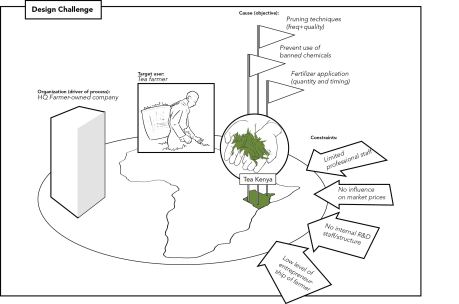
Design challenge

                                    Structure of the design challenge

We set the scene with a great introduction by Niti. Her work showed some of the patterns in the effects that uncertainty in cash income and in time, has on organizing life, work, and consumption in the informal rural economy. The intent of providing these insights was to invoke thinking on how closely and in what way stakeholders involve their users and user needs in the design of the actual value chain development programs they implement. We gave our groups full access to design support from the excellent JAM design studio (who also created all the presented visuals). The design sheet as shown above was simple enough, and the support competent enough to allow the group of non-designers to engage in a user-centered problem-solving exercise.

Insights on the multi-stakeholder working process
When the break-out groups re-convened after their design exercises, we asked each group to present their ideas, and discuss their assumptions and constraints with the audience. Across all presentations we discovered an interesting pattern. Participants found themselves to be confronted with an inability to associate with the user, deeming that area of the value chain apprehensive for conjecture about farmers’ needs, and too far removed in terms of values. In our attempt to lower the barriers to applying the user-centered approach through a free-form exercise, we apparently raised an inherently imbedded barrier to consider the user. Rather, participants insisted to direct their problem-solving attention to a more abstract, distant level of thinking (the value chain), or a particular part of the value chain that is more closely associated with Western values (working from the perspective of Nespresso, rather than the coffee farmer).  
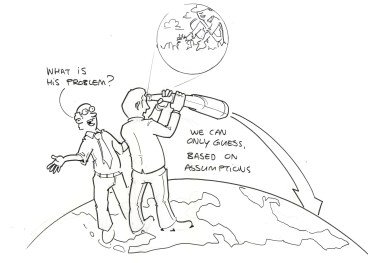
Distance from the user

Distance to the user (drawn in synthesis of workshop findings)

This inability to associate with the users had impactful implications for ways in which the groups constructed design solutions. The approaches used were vertical in nature, thinking only within the bounds of what would directly associate with production of a particular agricultural commodity. In their thinking on solutions, people diverted to general principles (tea production provides for income, and thus makes the farmers happy), and then divided the relevant principles into disciplinary segments (like finance, training, agronomy, trade, etc).

The solution for the cocoa farmer in Ivory Coast

A solution to the cocoa problem, but does the cocoa farmer want it? (workshop output)

Our groups’ working assumption appeared to be that creation of a conducive environment around the user (relating to the group’s particular focus area) would convince the user to adopt sustainable farming practices. Our working groups would define the elements of this conducive environment by using expert statements about the needs of the users. Expert opinion was thus applied as a substitute for direct understanding of the user. It provided the working groups with the sense of control they needed to make design decisions, relieving them from the uncertainty of the exercise. The upshot was that our groups created a logical construct for their solutions which circumvented the farmer, working around their own design constraint of not holding applicable user insights. 

Sustainable Value Chain 6

Experts say… (drawn in synthesis of workshop findings)

How would these insights translate to adoption of solutions?
Though it may seem a sensible way of working, the dependency on expert input actually creates a marketing problem for transferring innovations for sustainable development to farmers. Expert insight appears to displace the use of actual user-related insight to influence design. On top of that, the negotiation process underlying the solution which is provided, conducted by stakeholders here, leaves no control to the user to adapt it to her priorities.
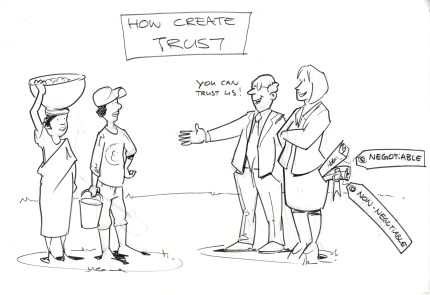
Negotiating and trust creation

The proposition as it is currently made (drawn in synthesis of workshop findings)

Such approach would thus preclude any method for calibrating a solution configuration to match to the priorities that are part of the mindset of the user. In fact the project’s offer could even be considered as a potential liability from the perspective of the user, who has to find (negotiable) ways to control for uncertainties like available time and money. “Your focus is not my priority” would be the mode of cooperation with farmers, likely causing mounting problems with trust, and adoption.

Perspective for bridging the values gap with the user
The value chain could in potential be used to achieve development results. But the workshop exercise has shown that we need to pay more attention to creating suitable interfaces for the exchange of values. This entails consideration of the following aspects:

  • First of all, it’s important to take segmentation of the targeted users into account. For instance, there is a world of difference between subsistence and below subsistence smallholder farming. Who do we want to target, and not to target?
  • Related to the first point, decision makers for value chain programs will need to obtain a higher sense-level about the user. This need not require an extensive profiling, but just enough up to date information containing a minimum level of scope and detail about the target user persona’s. This will support a more lateral perspective in decision making for solution development.
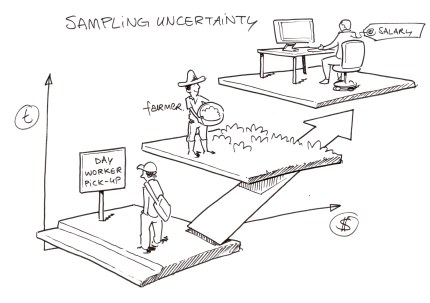
 Sustainable Value Chain 8Sampling and segmenting your users

  • Uncertainty is inherent to the challenge of value chain development in the informal economy. Experimentation is a far more likely management approach to deal with that constraint, than expert opinion. Before rolling out large programs, decision makers should at least have tested the smallest number of core features of the idea in their most minimal form with targeted users. Experiments could invite smart and small feedback loops to validate the concept, and inform decision making.

These points are a challenge to development. Allocation decisions by donors are not aligned to such approaches. Also, I have focussed much on insights that could help in increasing the likelihood of success. But in fact, in innovation practice, it is actually more common to learn from failure. In the way development is currently organized there are incentives to rather obscure failure than obtain traction in learnings from it. This is another barrier that needs to be overcome. Ultimately we need a vision on how we further our learning in development. We need to come to a discussion level of ideas where N.G.O.s are able to say to donors, ‘Don’t fund this, it doesn’t work.’ – should that apply.
——————

This is the fourth piece in a continuing series of posts (starting here) on what the role of human-centered design could be in development work. I’m working on this together with Niti Bhan, who will also be posting her observations at her Perspective blog. Posts are categorized as VCD

“What if” continued: reflections on business model innovation in agriculture

Since my post last month on a “what if” about farmers being able to participate in brand value creation with the consumer brands, I’ve received some interesting and inspiring responses. They come from people in executive positions at a leading global food brand, and at a commodities trader, as well as from a relatively well-known marketing innovation expert and blogger.

In this post I would love to share some of the insights of this exchange. Because it’s not appropriate to present the reactions with direct attribution to the respondents due to the informal nature of exchange, I have chosen to reform the responses into a fictive conversation. The conversation is between me, as an interviewee, and an “industry journalist” enquiring into next step innovations on sustainability, marketing and supply chain operations in food and agriculture. A little schizophrenic and unintendedly vain maybe, but bear with me…

Q: This idea you have connecting farmers to brand value and marketing is a nice idea, but isn’t this just a classic Michael Porter problem statement: some companies will prefer a strategy of backward integration into their supply chains, some won’t? If consumer brands use their resources for their producer partnerships, they will not be able to utilize them in their relations with customers.

A: The dynamics in agriculture is turning very much to the disadvantage for firms that have been divesting out of production for the last decades. Natural resources are dissipating; farmers are not investing in their holdings, or as less as possible, due to low returns. Both economic returns and the environment suffer. People have been moving out of the farming practice all over the world. That is economic erosion, and it is a compounding risk of food insecurity. We need new propositions to keep farming attractive. People need to actually be moving into the business, rather than moving out, and food companies need to innovate in our food systems to secure their existence as a commercially viable company. That is what motivated my previous post, pointing to the need for new types of entrepreneurial propositions to farmers that are beneficial to food industry at the same time. It was not so much that I wanted to “push” a specific solution.

Q: Ok, for argument’s sake, let’s say you have a point: aren’t you focusing too much on added (brand) value systems? What about the commodities business, would your argument still hold?

A: Right now there is so much decline of environmental and social capital going on as well as a mounting risk of food insecurity all impacted by developments at the level of the primary farming activity. It is aggravating to such an extent that preventing that decline or taking action to invert that trend is actually the fastest growing value creating opportunity in agriculture at the moment. This type of value is not concerned with company-to-consumer value per se, it concerns the whole agri-food system, thus commodities and branded products alike. I think there is great innovation potential for the whole sector in linking back the value capturing capacity of down stream to the up stream area in the value chain where all the problems are stemming from.

Q: Sharing value across the chain, isn’t that another form of wealth distribution, and shouldn’t we have learned over the years not to use that type of socio-financial engineering?

A: What we have learnt about that, I think, is that you can’t centralize the redistribution function, like through government and taxation. And personally I would say that banks and derivatives alchemy actually belong on that same list (hahaha). What I propose with my idea, rather, is to unlock the potential of market based valuation of solutions to environmental and social problems. We’re already spending money through redistribution mechanisms in developing countries for instance; it’s called aid, and it’s really not working that well because it is spent regardless of any result.

Contrary to aid, market based valuation is contingent on performance, on achieving a superior allocation of resources. Rewarding that type of performance is the ultimate entrepreneurial proposition you can make, and it spurs innovation. Just look at what’s going on in Silicon Valley. The opportunity of creating and capturing value in the tech market generates unparalleled entrepreneurial pull that makes people from all over drop everything and move to Palo Alto. I know things are a bit crazy there, but if we could only unleash, or distribute, that type of spirit to agriculture in some way.

Q: Just stepping aside from theory for the moment: It just seems so impossible to make this work from an operational point of view. How will you reach these farmers, and what if the stock price goes down?

A: I agree that the idea would be a laborious undertaking. You would need to get thousands of farmers organized under a vehicle that could hold the derivatives and distribute returns. But then again, we have been investing in the setting up of large numbers of, oftentimes sizable, farmers’ organizations, in both developed and developing countries for years. We’re already building such infrastructure to facilitate product flow through the supply chain. New value systems could be used to strengthen the economic foundations of such collective organizations.

Secondly there is indeed and important issue of valuation an attribution of value changes. I know that brand valuation is not an exact science, but is valuation ever?  But I think the need for valuation techniques could become so important in future that we should encourage more study, rather than put it on the back burner in solving the world’s food problems. Numerous companies have been developing metrics to track performance of their marketing departments using esoteric valuation methods. Also top-line ad-agencies use contingent contracting forms to determine their reward for advising their clients on advertising and creating brand value. Why not take it from there, and look at your producer partnerships?

Regarding the point of fluctuations in stock prices, I would say that if attribution can be correctly constructed, it then wouldn’t really matter if value drops. It would mean that performance has gone down accordingly. Remember, that the idea is intended to be an entrepreneurial proposition; no performance, no reward, and each partner carries the risks of the joint value creation endeavor accordingly.

Q: If the example you provide is not actually a real solution as you say yourself, or at best too complicated, what would you then propose to do? What can companies practically work with to start on the agenda of new value systems in food and agriculture?

A: Propositions to farmers in developing countries like access to finance, fertilizer, and roads is part of the needed support and often already provided. But it is not sufficient a proposition to create new entrepreneurial zest. Such propositions merely reinforce the current contracting positions of farmers, and we all agree that this is not a very attractive position.

There are also calls for structural reforms in agriculture, like disowning small and uneconomic holdings, thereby providing room for large scale investment.  But we then get back into the old redistribution dilemma, and consequent problems.

I think that relations in agriculture will become more dependent and thus more specific, given the business environment we’re in now. It is high time we re-imagineer producers as suppliers, to producers as customers. My suggestion would be to start designing partnerships as you would a design a business model for your actual customers. This would create the much needed relations for joint value creation, and the sharing of returns. It would catalyze the innovation we need to create a sustainable foundation for food and agriculture.

————————–

I would like to thank Joost Guijt in directing some interesting contacts to my post, and inviting their response. Joost is a member of the Value Chain Generation, and developing the Cotton Coversations startup.

Although this post has been a sort of conversation with myself, I hope to invite more discussion in the commentary string below. I look forward to receiving your thoughts and responding!