Imagine you live in rural India and you own a motorbike. Every once in a week or so, you are approached by a passer-by or a neighbor to help out because his bike has run out of gas and the nearest station is 16 kilometers away. Sometimes they’re lucky. You have enough gas to share and you’re able to perform the icky job of siphoning off your gas with mouth and hose. People even pay you extra for your discomfort, enabling you to buy a pack of gum to clear away the taste from your mouth.
So, after a couple of times of doing this, and the unintended near swallowing of petrol, it hits you! Could there by a market for this? Could I build a filling station with the purpose of helping people reaching the next village? A solid discovery of a customer problem, and a potential solution to tackle that problem.
Now the question is what a physical prototype of your business model would look like. Fortunately you’re strapped for cash at your 2 dollar a day income, imperative for lean decision making. It prevents you form asking the wrong type of questions for your prototype like:
- What colors should my uniform be to look credible enough for my customers to buy from me?
- Do I serve Coke or Pepsi at my station?
- How about a drive-through bike wash?
In this case you need to earn before you spend. So no, it won’t be a lavish, fully furbished, high-tech unmanned petrol station. It might look more like something below:
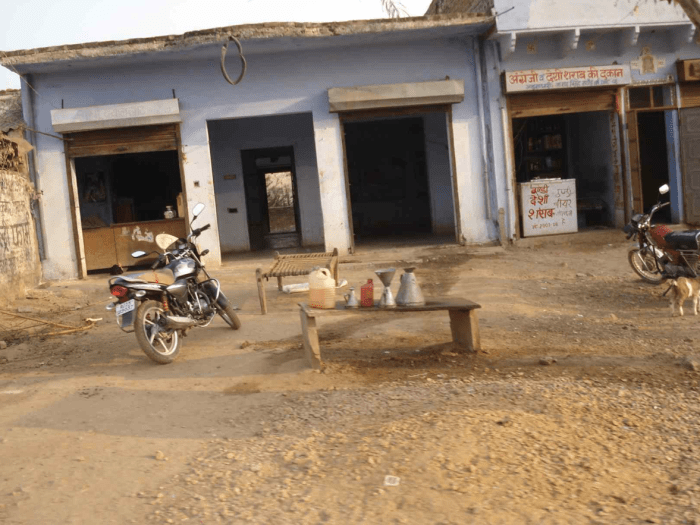
….the Minimum Viable Gas Station (photo credit to Niti Bhan).
This prototype would be the most reduced concept (generally referred to as the Minimum Viable Product (MVP)). The MVP enables you to test the most essential parts of your business model: How do customers interact with and value my product? The downside is that it looks scrappy, but the dominant positive side is that you will naturally test better questions about your business model:
- Would customers pay extra for this type of filling service? And, how much?
- What volumes will they need, and how much stock do I need to keep?
- Is there a pattern in demand which is prevalent throughout rural areas?
Through such essential questions you are also more inclined to focus on gathering essential data for testing your idea. So it’s not so much the total number of motor bikes that zip by your station that count as an indicator for the potential of your idea. Depending on that in your case will make your family go hungry. Naturally, it’s the number of people that actually make a stop for a fill that does.
What’s more is that through playing with pricing, you might discover that customers are willing to pay 4-5 times the market rate for petrol, because your service saves so much effort (so radical affordability as the main constraint in servicing the BoP appears to be an assumption). Now you have found the essentials for scaling a profitable business: franchise anyone?
What we can learn from the makers
In short the MVP emphasizes what matters, and prevents you from wasting resources on testing the non essentials and using non-essential data. But conceiving your MVP is hard. How do you define your product in the most undressed way possible to test your product and its features? It is even more difficult to build an MVP for physical products like a gas station than for a web application (where the MVP concept naturally originated from), as you often incur more costs in time and materials to test them.
But, as the example in rural India shows, constraints like money and time spark creativity and can invoke “the maker” in all of us. Play around with representation: there is always a prototype! In our case we redefine the gas station to a jerry can and a funnel: the smallest representation with which all essential features of a gas station can be tested. People like Steve and Woz of Apple started out with just a motherboard.
Invest in defining, and cutting & pasting your MVP. It keeps you from carrying around stupidity for too long; it prevents you from filling the bucket with so much water that it starts spilling over the rim once you start walking. Build with less.
 Partnership Design