Agriculture is the main driver of the rural economy in developing countries. Realizing product and service innovations targeted at these agriculture-based markets holds tremendous potential for creating new growth engines for business, as well as achieving social and economic development.
While this is a market with huge opportunity, it is also very difficult to navigate. Much of the rules and patterns of behavior are based on informal solutions to irregular and low incomes, semi-literacy, and social and environmental uncertainty.
Estimating your market in such an economy is not a likely task. Insights are yet to emerge on the radars of formal market intelligence approaches, like the chamber of commerce, or Google analytics, etc. And, if there’s little else to target specific customers by, than referring to them as a number of 2 billion or so people who grow crops on small pieces of land and rear animals, your business is likely to fail.
Needless to say, emerging rural economies require different market estimation approaches. We need to be more creative and develop proxies, which are more sensitive to picking up signals of upward market dynamics.
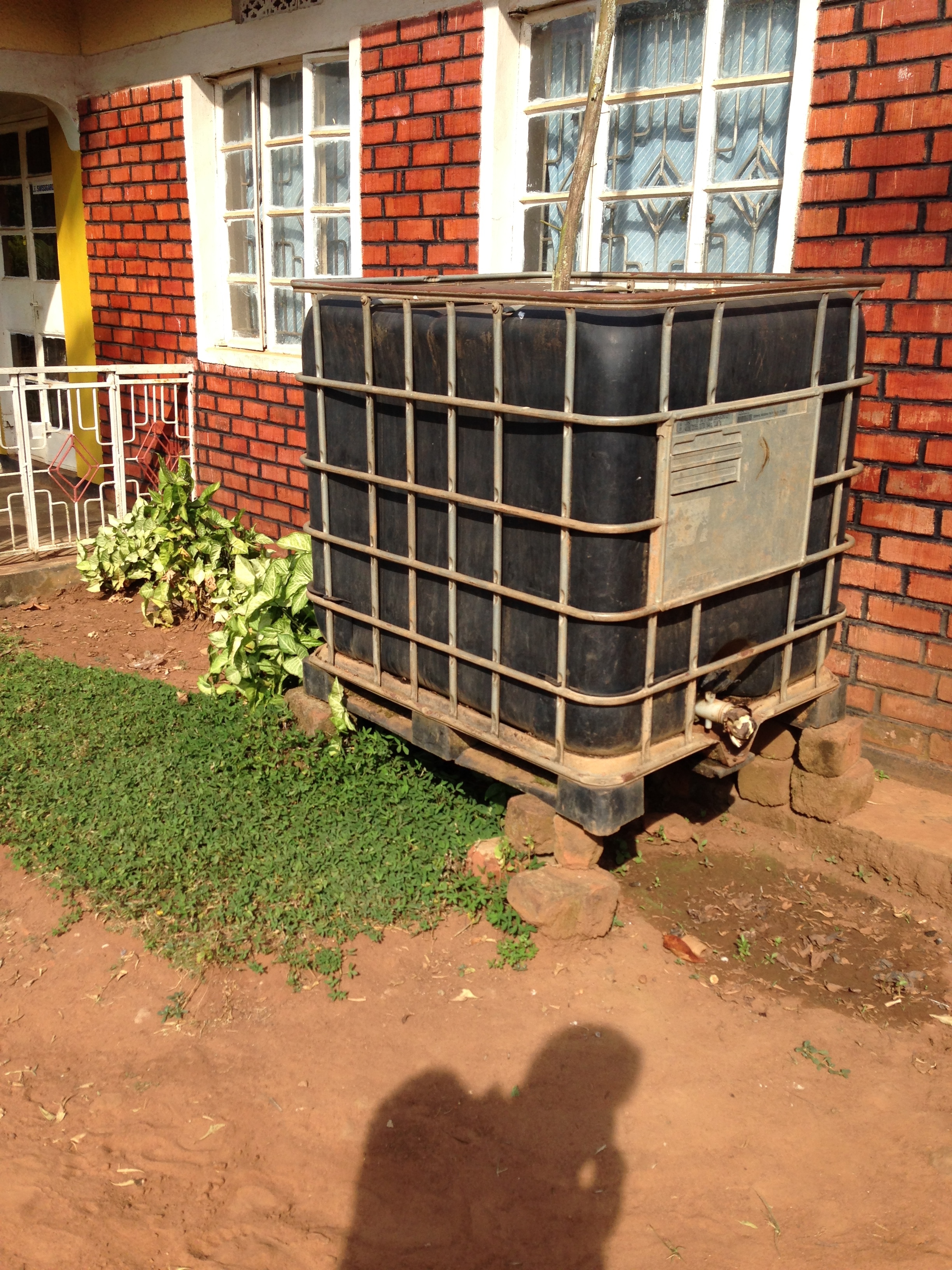
The water tank indicator I recently had an idea for such a signal, based on some photo’s I took of water tanks during fieldwork. I still need to validate this thought, but I’ll write it out here, for sake of argument (I’m open to your comments!).
A water tank located near your home provides a lot of convenience. You can collect rainwater in substantial volumes that can be accessed from your own premises. Also it could help you eek out your water supply during the dry season.
The very common alternative to the water tank, is to walk to the water pump or the lake with a jerry can, for which you often need to cover substantial distances. Water tanks thus create a considerable saving on time and effort dedicated to fetch water. Time that can be freed up for other activities on your farm or on someone else’s farm.
Water tank in North Buganda Region, Uganda
Occasionally you will find a household that has invested in a tank, and my experience is that these are relatively well-off people, because water tanks are a big investment (or an NGO has dropped by with a program…). Could water tanks be a soft signal for upward mobility?
Now correlate this line of thought with a photo I made in Kagio in Kenya below. What would such an inventory of water tanks signal about the overall wealth dynamics of the area around this town?
Water tank inventory in Kagio, Kenya
What we could do with such insights I don’t know whether the water tank story will hold up if I try to validate it. But if it does prove to be relevant, it could be a very interesting indicator. It could help determine great locations for piloting or launching a new product or service for an emerging market segment with purchasing power. I think you could also use remote sensing data to locate such water tank inventory points, as they’re pretty conspicuous. This market sizing indicator might even be brought to scale!
The big question is whether it would be worthwhile to invest in digging up more of these insights. If we can create a validated set of such context-rich indicators that can be brought to scale, then we can inform the emergence of new growth pockets in a very resource extensive way. I think it might be worth a shot! Do you?
Take-aways:
It’s hard to estimate the size of your market in an economy that is yet to emerge
If you want to take a new group of 2 billion non-customers online, then you need to become smart about your targeting methods.
It might be easier to infer purchasing potential from a water tank, than through formal survey methods that filter out the demographic that has that extra dollar per day to spend.
According to the IFAD (International Fund for Agricultural Development), 3 billion people in developing countries live in rural areas. Agriculture is the main source of income for 86% of this population. Within this farming community, smallholder farmers make up the bulk of farmers (for more stats see the FAO rural economy fact sheet). Arguably, they have contributed substantially to the growth that many developing countries have experienced over the recent few years, not unlike SME’s being the motor behind Western economies. Smallholder farmers are thus an important group for working together with in our global ambitions of creating social and economic development (as demonstrated by the UN initiative of proclaiming 2014 to be the year of the family farm).
One of the leading strategies in developing smallholder farmers is providing them with knowledge and information on agricultural practices. The idea is that this will improve practices, make production more sustainable, and improve operations of the market. Given the increase in dissemination of (mobile) technology communication devices, there also appears to be a huge potential for reaching scale with ICT’s in outreach of these information and knowledge dissemination approaches.
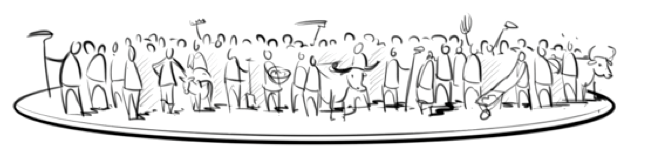
Smallholder farmers by Jeroen Meijer from JAM visueeldenken
Despite the significance of the group of smallholders and the opportunity at hand, there is still a lot we are yet to understand about them. The majority of their lives take place in informal economic settings, where local activities and rules apply that simply do not light up on the formal business development radar. There is no real understanding available on their everyday lives and priorities. For instance the chocolate multinational considers the cocoa farmer, simply because she has a cocoa tree and supplies cocoa to the world market. But this farmer herself might see things differently:
I side-sell some of the milk to keep my husband from spending the earnings on anything other than our kids’ school fees,
I need to learn from a cousin about rearing rabbits to serve the growing number of road side dining stalls opening up in town, which are willing to extend me a loan to start operations,
I’m skipping dinner tonight to save up for airtime so I can call that trader which has recently been asking specifically for that variety of mangos. It will save me the hassle of getting produce transported on market day and getting a raw deal in any case.
There is thus a huge gap in understanding, aggravated by the sheer number of people we’re talking about, and we have little basis to relate. As there is no substitute to fill this lack in understanding, smallholder farmers are oftentimes unfittingly lumped together in service and development program designs. There is no basis for targeting innovations to specific groups, nor obtaining specific feedback about what works for whom, and what doesn’t. The result can only be that a lot of the available information and knowledge doesn’t arrive or ‘stick’. A majority of smallholder farmers is likely to be underserved and under-utilised in their capacities to contribute to economic and social development.
We need to drastically enhance and update our understanding, if we intend to reach out to the smallholder farmer. And we should start with the basics such as:
Different mental models that farmers use for managing and operating their farms, which would reveal particular workflows and basic farm decision making foundations
Basic technology usage patterns that would reveal insights on user experience design requirements
Rules and systems that apply to the informal economy context, as well as business models that are currently successfully serving farmers.
The role of community and networks, and their social conventions and taboos, which make up the existing ecosystem in which the farmer organizes her life.
Lastly and most importantly, we need to understand farmers’ aspirations, and how to appeal to those aspirations, to provide an adequate basis of relation.
A proposition
It is evident that such research needs to be done, but it shouldn’t be done for research’s sake. Rather, understanding needs to be turned into actionable insights. What if we could develop processes, tools, and personas which would aid in segmenting farmers in a specific context for targeting innovations? Support materials, which would capacitate companies, CSR initiatives, and dedicated organizations working with smallholder farmers to design and build for their specific purposes in agricultural product and service development.
Process and tools for achieving segmentation by Jeroen Meijer from JAM visueeldenken
The aim would not so much be to directly provide solutions, but more so to put the design process and tools into the hands of the people who are most closely related to the problems at hand. On top of that there would be a need for continuous adaptation, tailoring, and distribution of such a resource to different and changing contexts, as developing country economies are in continuous growth flux.
Boldly stating, I say that such a resource would need to be developed and made available in the form of an organisation with a public purpose of overcoming our current common barriers to purposeful marketing to smallholder farmers. This would be a social venture, which would maintain itself by publically providing, tools, processes, and basic insights to customers. Furthermore this organisation could help out in tailoring to specific business and service development interests, based on agricultural practices, but fanning out into other areas like finance, insurance, farming input sales, sourcing practices, extension services, agribusiness sourcing, etc. To give the vision a name, I have dubbed this organization Ardhi, which is a holistic term in Swahili signifying soil, ground, or suitable (farm)land.
Insight and understanding of the farmer by Jeroen Meijer from JAM visueeldenken
Further idea development
Now I do warn that there is no clear fix for this initiative. We have the basic design tools and technology resources available, but they need to be tailored and refined towards a new market setting through the only way possible: practical experimentation and learning. It will thus be a journey, one which I would like to invite you on to as well.
I am part of a dedicated consortium, which is ready to start this research journey by looking into the space of information and knowledge exchange relating to agricultural practices. Over the past year, we have been enabled through seed funding to conduct a feasibility study in Kenya and India for our research, and compile a research plan (several insights previously published under the VCD category on this blog). We combine the skills of design, technology and agriculture for emerging markets. Leading this consortium are:
Bart Doorneweert, agriculture researcher at Wageningen University Syamant Sandhir, tech specialist at Futurescape Ric Edinberg, design researcher at Insitum
Together, we would like to hear from you about your interest for our initiative. Specifically we are looking for people and organizations that can help us on our innovation journey through either:
Field work collaboration- Involve us in projects in the early scoping and design stage
Testing research process and tool prototypes, and applying preliminary insights- Private sector and NGO parties collaborating with private sector who are interested to obtain and apply early insights and actively co-create methods and materials with us.
Providing broad-based funding support for deep-dive research to develop materials and insights, and seek the limits of their application. – Funding organizations that support the idea of strengthening the ecosystem of service and product development for smallholder farmers.
If you are interested to be involved, then do make yourself heard by dropping us a bit on your background and interests here. We look forward to hearing from you, and hopefully engaging with you in the near future! Do keep track with the progress of our journey under the Ardhi category of posts that will come.



 Partnership Design