I’m grateful and humbled that Dave Gray allowed me to post this tool amongst the collection of the other valuable visual gaming tools. Do browse through more of this Wiki if you want to realise more effective exchange in your brainstorms, and decision creating/making. Also check out the Gamestorming book, which contains more support in setting up visual meeting workshops.
The partnership canvas as is, is just a first launching feature for a product that will help in the partnership design and implementation process. If you’re interested to learn more about the new developments around the canvas and are eager to test out/suggest new features, then read the introductory blog post to the early user sign-up page, and register. As soon as we have some new experiments to run, we’ll get you involved!
Interested to learn more about Partnership Design?
Partnerships are an odd part of the business model. It’s often very difficult to understand them, or even figure out if you’re really looking at a partnership in the first place. Recently I encountered such a weird case, when I read a headline about booze multinational Diageo, partnering with a scrappy hipster startup called Bespoke Post. Lets find out more about this partnership in this blog post by applying the newly designed Partnership Canvas; an add-on tool to the Business Model Canvas
The two partnering companies Diageo is a global player in marketing alcoholic beverages. It holds big brands like Guinness, Johnnie Walker, and Smirnoff. The company had sales of € 15 billion in 2013, with a strong growing emerging market presence.
Bespoke Post is a online subscription-based product box startup. The startup has a highly targeted approach for selling gift boxes filled with artisanal, high-grade products, both food and non-food, to young US career makers with cash to burn, aged between mid 20’s to mid 30’s, and mostly male. This startup landed a seed round of US$ 850k early 2013, and is probably still figuring out how to generate revenue.
The big question is: what on earth are the elephant and the mouse trying for on the dance floor?!
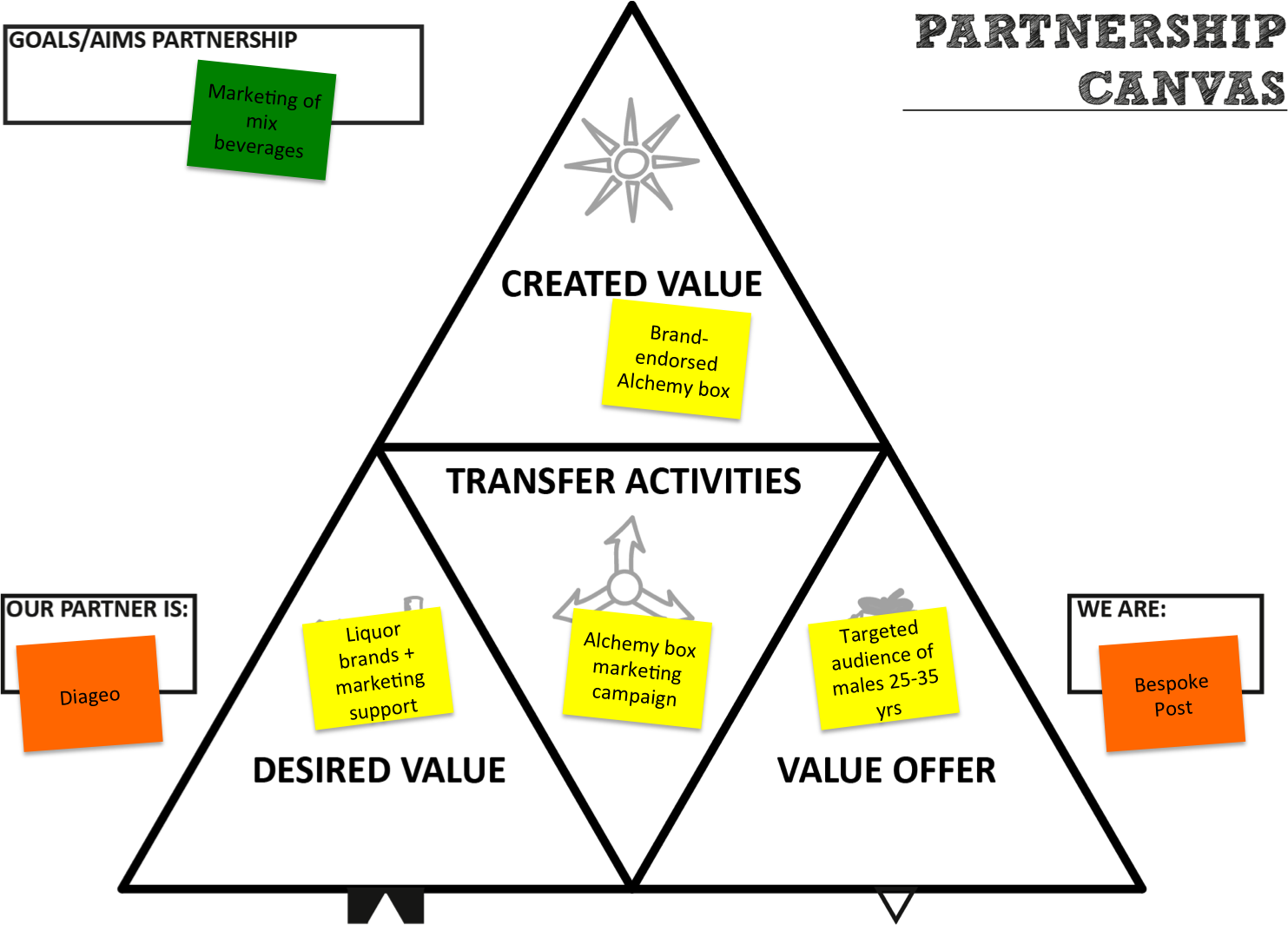
On the face of it, it seems that Bespoke Post pitched the right concept to Diageo. Bespoke created a product box called Alchemy. It contains the essential wares in any mixologist’s den, as they put it. The pitch would be that Bespoke Post offers a joint marketing initiative, where they provide the hardware for mixing, shakers, and bar spoons and all, and Diageo would supply the required liquors to enable the mixing. The accompanying video with Diageo’s “head mixologist” applying herself to the toolkit would seem to give that impression. (Here’s how to make a Manhattan) Sketched out in a partnership canvas, the partnership would look something like this
Bespoke Post – Diageo partnership at first glance
But something odd is going on. With this given partnership foundation (the bottom 3 building blocks), it’s impossible to come up with a logic what new value this combination would be able to create. Couldn’t Bespoke Post just purchase the liquor, put one of their own staff in the video, and sell the box themselves, or vice versa? Is this actually a partnership?
Prompted by this caveat in the partnership logic I looked a bit closer at the Alchemy box. If you look at the box content, you’ll find that there is actually no liquor in the box. It’s just the hardware that gets sold with the Alchemy box, accompanied by some mix recipes, which promote the well-known branded alcoholic beverages. So what’s this all about? There must be some other value that gets exchanged to make this a partnership.
Legal print
The answer comes from elsewhere. Digging into some articles on the legal constraints imposed on marketing alcoholic beverages, I found this Wall Street Journal blog article, which explains new legislation for advertising, and marketing alcoholic beverages on social networks. Apparently alcoholic beverage advertisers have to meet a requirement that at least 71.6% of the social media advertising audience is old enough to legally drink alcohol. That’s quite a tricky limit to take heed of. A company could find itself easily crossing that limit, be it intentionally or not.
So my hunch is that this is where Bespoke comes in as a solution. Bespoke Post is a highly targeted initiative that addresses a key demographic of Diageo customers. Bespoke might be Diageo’s marketing experiment to avoid the risk of having the wrong audience engage with its social media advertising. This partnership could well be an experiment to see if an initiative like Bespoke could actually be a social media advertising tool for Diageo. Having this logic sketched out in a partnership canvas, you would get something like this, which makes a whole lot more sense partnership-wise:
Bespoke Post – Diageo partnership upon closer inspection
Key take-aways Apparently the experiment didn’t work out that well, as the Alchemy box is not offered anymore by Bespoke Post. But the example is interesting to show the potential of using partnerships for business model experimentation. This specific case highlights the following learning points about partnerships:
A partnership is not about the transaction between 2 businesses. It’s about a non-monetary value exchange that takes place between partners.
When figuring out a partnership, try to formulate the logic of the foundation of the partnership (the 3 bottom building blocks of the partnership canvas) first…
… but don’t leave your thinking at the foundation. Also think about the value that needs to be created based on this foundation. A partnership needs to create some new form of value as a result of connecting the existing values that partners contribute.
By connecting all 4 building blocks of a partnership in a single logic, you will make surprising discoveries on what the true color of a partnership is.

 Partnership Design